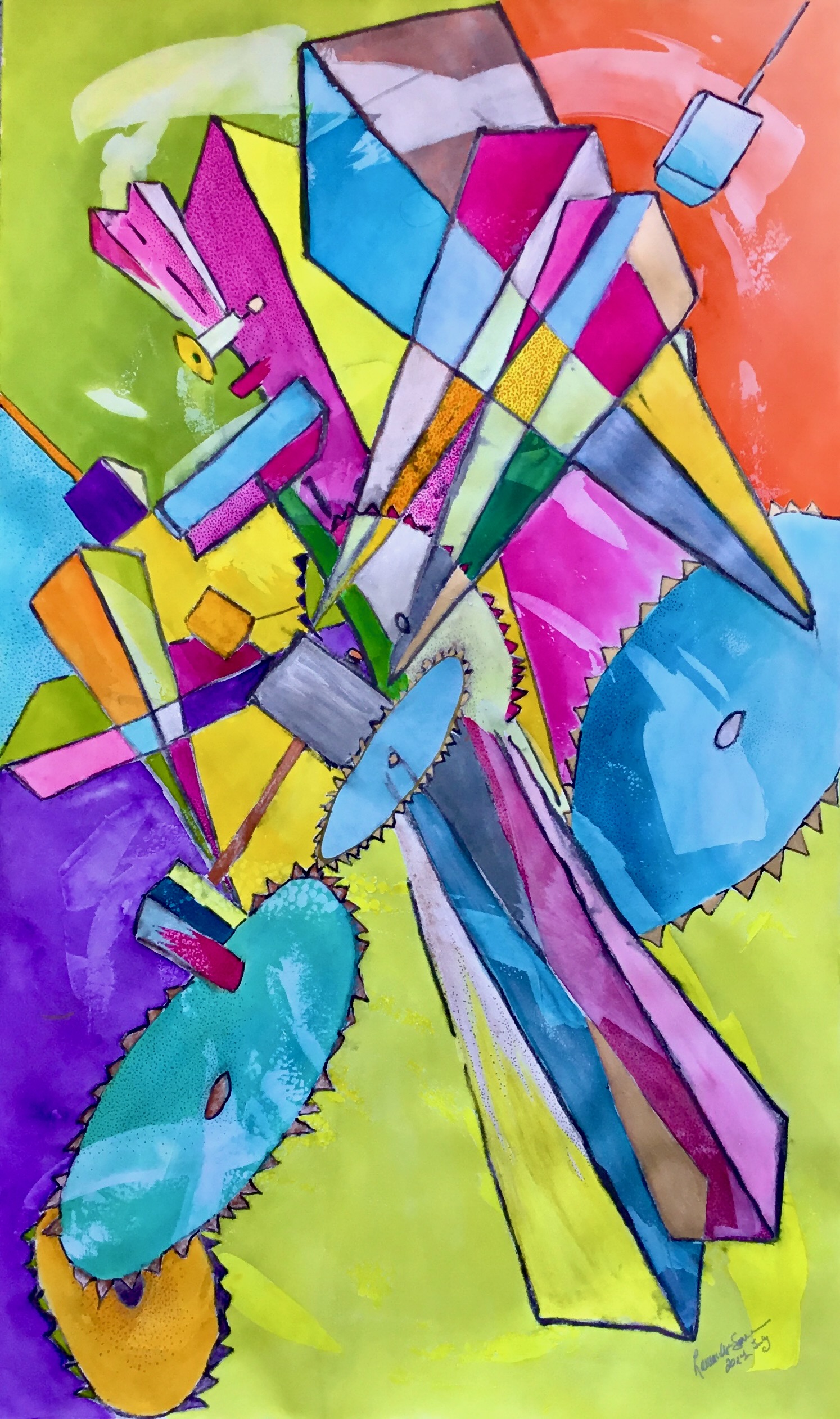
Watercolour
Daniele Lamarche-Sarvia
Danièle Lamarche-Sarvia began her artistic path at fifteen, studying life drawing at the Montreal Museum.
Artist Profile
Danièle Lamarche-Sarvia began her artistic path at fifteen, studying life drawing at the Montreal Museum. After graduating from an alternative arts school in 1974, she pursued Fine Arts across several institutions, culminating at Beaux-Arts/UQAM. Her early career as a graphic artist introduced her to digital tools like Photoshop, though dyslexia posed challenges. Inspired by her anthropological heritage, Danièle worked across Mexico, Canada, France, India, and Kenya before settling in Australia in the 1990s, where she raised a family and reconnected with her art practice.
Her work—spanning watercolours, sculpture, printmaking, and ceramics—reflects deeply human themes: love, mental health, joy, and social commentary. A figurative expressionist, Danièle is known for her gestural, ambidextrous drawing style and her poetic, emotionally resonant pieces. Preferring cotton rag paper over canvas and watercolour over oil or acrylic, she continues to create from her Brisbane studio. She has exhibited solo in cities across Australia and Asia and is followed by collectors worldwide.
Artist Interview
What medium do you work with, and why have you chosen them?
The final year at Beaux Arts school demanded us to produce a self portrait. Arrogantly I thought I was going to be exempt since I was an emeritus student but they challenged me if I was not doing like demanded I was going to be failed, so I produced a watercolour face and 3/4 portrait in watercolour on paper and won the first prize for it. Watercolour is none toxic and it is pure pigment and cotton rag paper as its name says is cotton durable malleable a real pleasure to play with. Now the fluidity of the watercolour corresponds to my temperament and I love playing with it layering it to opacity sometimes because its versatility is infinite. it doesn't smell, it can be worked in enclosed spaces and easy to travel with.
How does your artwork get from initial concept to exhibition stage?
I need at least a 3 steps concept development. I have drawings and photos that I use as reference its my visual dictionary from which I draw the idea of what I want to express. Then draw other version most of the time amalgamate different drawings. My third step is with scissors . I cut the parts I like from the precedent drawings then I collage, I compose something else. I often have 4 to 6 drawing versions to play with cut and assemble. Then I take my cotton rag paper and reorganise the collage composition . This version will have the main elements as the details will grow on me as I go. the work is alive by itself It dictates often its meaning. The colours come as I develop the painting I never really decide of the colour as the mood is created as it develops on the paper.
Can you tell us a little more about your creative working environment/studio?
I am a neat person. Every time a painting is completed there is a break and I clean the studio but while I create the painting there is chaos. Sketches on the floor on the wall visual diaries open and thrown on the floor cut pieces everywhere. The white working surface become chaotic full of colour marks . I am obsess with purity of my colours and change the water continuously so there are pots all over the table in different sizes and I wash my brushes religiously. I use the special brush soap. I have brushes that are for the time I was studying in Montreal .
Career Highlights
- Fire sculpture Wynnum Festival 2014
- Singapore solo show sculpture, prints 2007
- 2019 Sassy solo exhibition Moreton Bay||PARAGRAPH_BREAK||